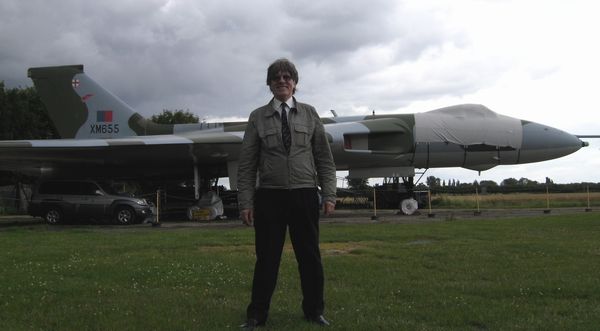
| July 2009 | |
|
From July 2009, after a break of 8 years, instructing again at Wellesbourne, near Stratford. Its the club with the Vulcan parked outside....
|
|
|
|
|
|
Vulcanology Outside the flying training club where I work at Stratford there is an aeroplane parked up, slowly trying to corrode away. It is no ordinary aeroplane, not even the same shape that most aeroplanes are - it has no tail plane but instead one gigantic delta-shaped wing. It sits there, year in and year out, grandiose and resplendent in it's blue and grey camouflage, like a sentinel guarding the club, the airport, the empire! (for sure it doesn't know the empire has faded and equally for sure no one has the heart to whisper such a blasphemy within it's earshot). It is a 'Vulcan' bomber and it is big. It's massive wing swallows up four engines of a type that became the basis for powering Concorde, and the whole delta shape of the Vulcan was a precursor to the supersonic design. The difference is the vintage - whereas Concorde first appeared in 1969, the Vulcan is almost twenty years it's senior, first flying in 1950. But there are dark things about this behemoth - the darkest being that it was designed to atom-bomb Russia. And it's name - 'Vulcan' - is also suspicious, belonging to no English town, city or settlement that I know of. Not only is it not named after a town, it is also not named after Lieutenant Spock, as much as this knowledge will devastate the Trekkies amongst us. On the ground it is a giant camouflaged gazebo which I often walk under between training details, gazing up at it's cavernous bomb bay, lost in a daydream where I see it loaded up with nuclear nasties, it's engines revving away, while inside five freshly shaved young men talk numbers to each other in their professional clipped calm as they go off on their mission to end the world. I climb inside it. In the cramped compartment, over to one side, is a metal box with 'Handle Like Eggs' stencilled on it. I ponder what manner of foul genie lay stowed in that container, waiting for the coded call to set it free. Up in the cockpit, I squat in one of the two ejector seats (the other three guys down below had to jump out of the bottom). A Red painted handle glares at me, daring me to pull it - a note suggests that the firing pins have been removed, but have they?? Around the windows, a thick nylon curtain lies coiled, ready to pull down when the bomb is dropped, so that you will be preserved from the blinding flash and able to see where you are going. Able to use your eyes to fly back home and see for yourself the black lifeless ruin it has surely become. The Vulcan was the product of the Avro company but I have it on the authority of the Encyclopaedia Maximus Galactica that ever since the invention of the catapult, all Avro company bombers have been named after an English city or town (we all remember the 'Lancaster', even if we've never heard of the 'Manchester' or the 'Lincoln'). The strange fact is, my extensive library of maps does not show a place called Vulcan anywhere in Great Britain. But there must be one somewhere, because there is definitely an Avro Vulcan bomber parked outside our flying club. There must be a place called Vulcan, probably even a county called Vulcanshire. There must be citizens called Vulcans - or Vulcs for short, and the thing is, the more I ponder this machine, the more I think I am one of them! For I belong in that place where memories live, where the past refuses to be pronounced dead, where the dead refuse to be buried, a place colonized by those among us who are stricken with the malady called 'nostalgia'. And it's not just me…. Looking out from the clubhouse, I constantly notice a curious thing: The Vulcan's final trip to the scrap heap is forever being put back by a dads-army posse of unsung heroes. These 'Vulcs' (they must be Vulcs), are Royal Air Force veterans who spend their own free time lovingly attending to the many demands of this venerable machine. After striking up conversations with the Vulcs I have become privy to many interesting snippets of information. 'Our' Vulcan is one of the last ones made - a 'B2' (that means bomber mark 2). I can reveal that a mark two is distinguished from a mark one by an extended tail which houses electronic jamming equipment, and small protrusions under each wing which betray, like the glint of a concealed dagger, the evidence of betrayal in high places, for these hide the stubs of pylons where the Skybolt stand-off missile was to have been attached. The Americans thoughtlessly went and cancelled Skybolt after Her Majesty's government had gone and built these planes to carry it! But thankfully, the Vulcan was never called upon to fulfil its primary duty, and never dropped anything in anger except a few ineffectual bombs upon Port Stanley airport in the Falklands, in 1982. Yes, unrequited history is built into this aluminium artefact along with all the substance of drama, glory and heritage, and that is why these men scurry so tirelessly about it. For one day the glory must finally be gone, but please, let it not be today. I understand that! But then, I am a Vulc. From Patterns in the Chaos © David Scott-Morgan |